
After years of austerity politics and economic transformation that devastated working-class communities, workers, religious leaders, and community activists came together to fight for a living wage in Los Angeles. The idea behind their campaign was simple—all working people deserve to live in dignity. But to win a living way, organizers had to build take on entrenched political power. Their victory over the opposition of the mayor and the city’s powerful business interests demonstrated the effectiveness of their community-based, coalition approach to municipal governance. After victory in Los Angeles, organizers took the fight to cities across Southern California, and eventually to raise the minimum wage at the state level.
1975-1986
Plant Shutdowns
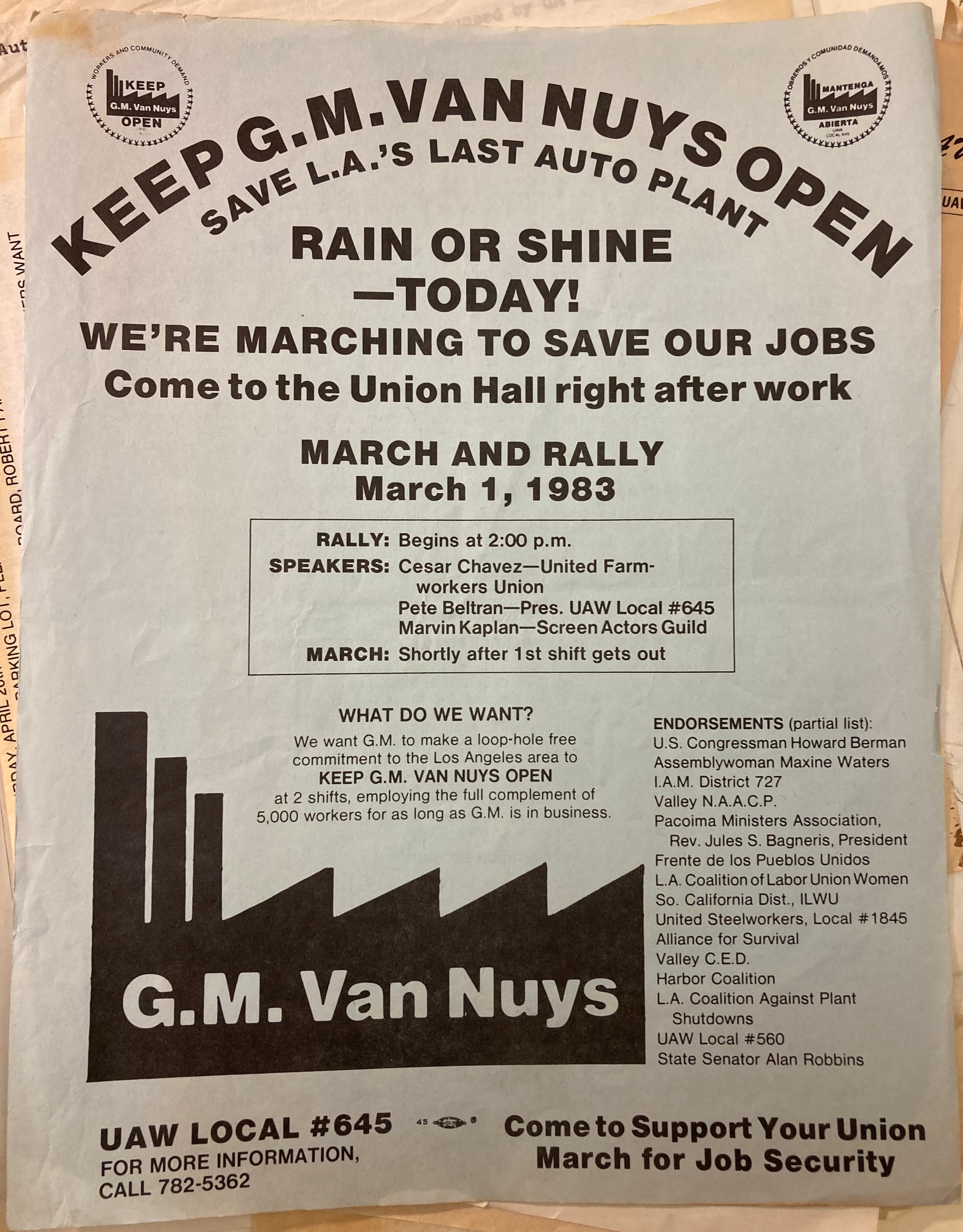
Altogether, eight major plants employing more than twelve thousand blue-collar workers closed down in South L.A. between 1975 and 1986, devastating the neighborhoods around them. But workers, unions, and community organizations fought back, forming new coalitions like the L.A. Coalition Against Plant Shutdowns to mitigate the impacts of capital flight in Southern California.
1992
ReBuild L.A.
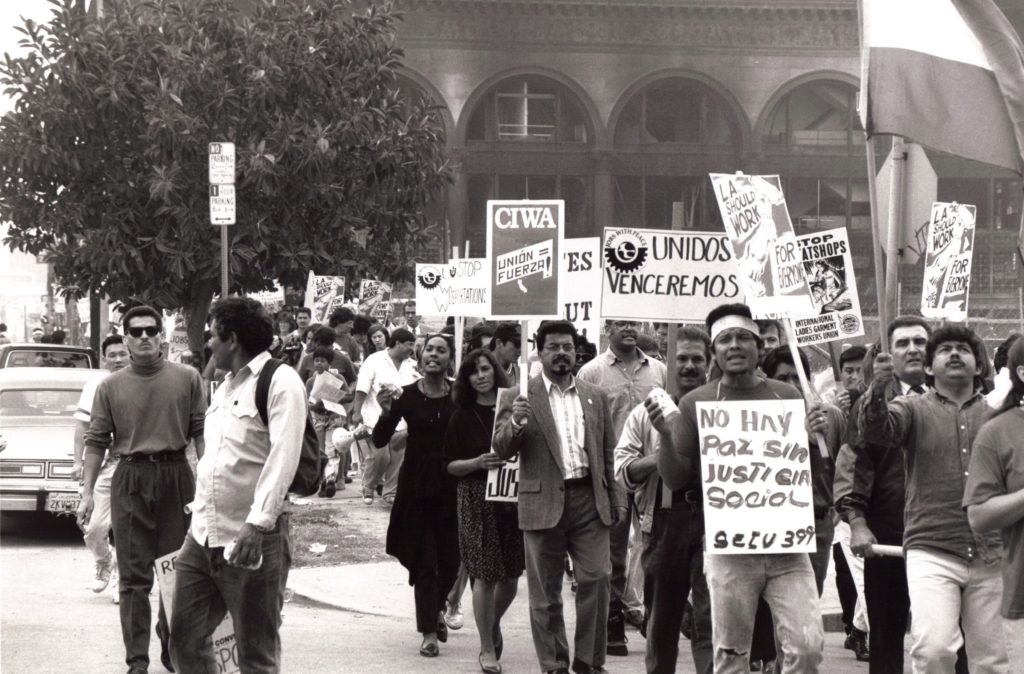
Following the 1992 Los Angeles Uprising, the City of Los Angeles formed a public-private partnership called “ReBuild L.A.” to oversee the reconstruction of impacted neighborhoods. Unions, immigrant rights and community organizations rallied to ensure that “ReBuild L.A.” would live up to its promises of economic revitalization and job creation for black and brown workers.
1993
TIDC
With financial support from HERE Local 11, the Tourism Industry Development Corporation (TIDC) was established with Madeline Janis-Aparicio as its first director. With the goal of conducting strategic research and developing policies that would support workers in the city, the TIDC’s first proposals were a set of wage and worker retention policies that became the Living Wage Ordinance. Following its passage, the TIDC was renamed Los Angeles Alliance for a New Economy (LAANE).
1994
A Living Wage in Baltimore
In 1994, the City Council in Baltimore, Maryland voted to pass a living wage ordinance, the first of its kind in the nation. Led by pastors with BUILD (Baltimoreans United in Leadership Development) and AFSCME, the passage of the legislation increased the minimum wage for workers in the city from $4.35/hour to $7.70/hour, marking the first major victory of what became a national movement.
Spring 1994
Privatization at LAX
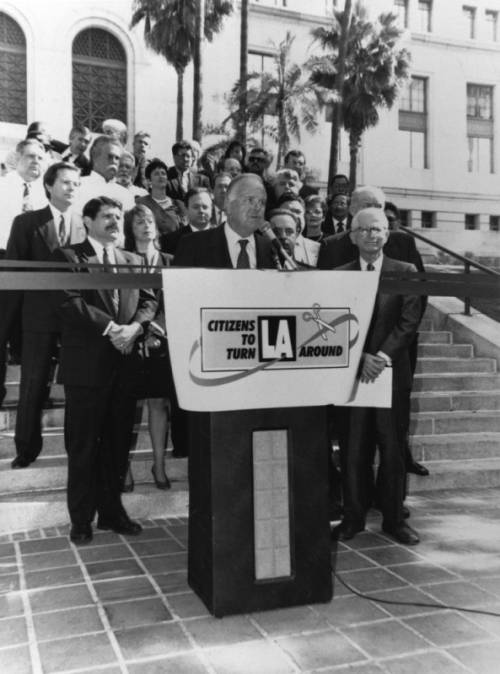
As part of his effort to balance the city budget, Mayor Richard Riordan announced his intention to privatize various municipal services by turning them over to private firms. The impacts of his policy were particularly acute at the Los Angeles International Airport (LAX), where he appointed Airport Commissioners that gave the airlines “free range” to subcontract their services and break long-standing union contracts. Soon, some 300 workers at the airport, represented by SEIU Local 399, had lost their jobs. SEIU began to mobilize to prevent another 700 layoffs and organize thousands of other non-union LAX employees.
Fall 1995
Retention Ordinance
With support from union allies, LAANE successfully campaigned for the passage of a workers’ retention ordinance at the Los Angeles City Council to defray the impacts of Riordan’s privatization of city services by requiring companies who received new contracts with the city to retain the existing workforce.
May 1996
A Living Wage in Chicago
Led by SEIU and ACORN, a coalition of 60 organizations, together representing 250,000 members, began the fight for a living wage in Chicago. Mayor Richard Daley opposed their efforts, the campaign cresting during his bid for re-election in 1998.
Spring 1996
CLUE
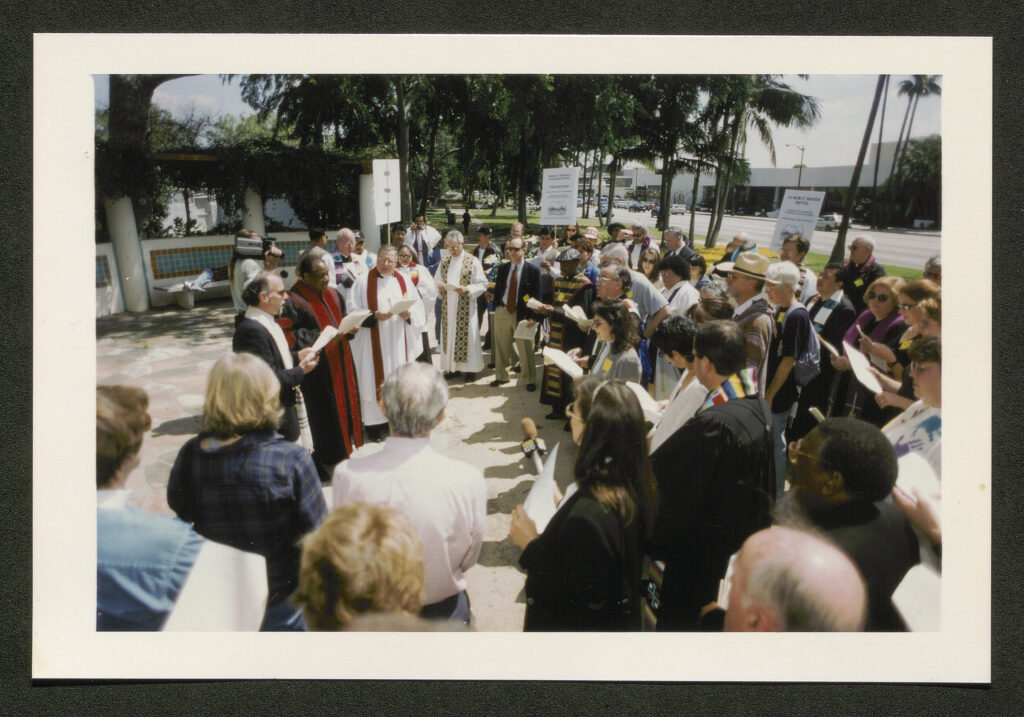
Brought together by their support for the Living Wage Campaign, local religious leaders established their own organization, Clergy and Laity United for Economic Justice.
Summer 1996
California Minimum Wage
State Senator Hilda Solis introduces SB500, legislation to increase the state minimum wage to $5 an hour. The bill became Prop 210, which California voters approved by a solid majority in Nov. 1996.
Summer 1996
Hold the Line Caravan
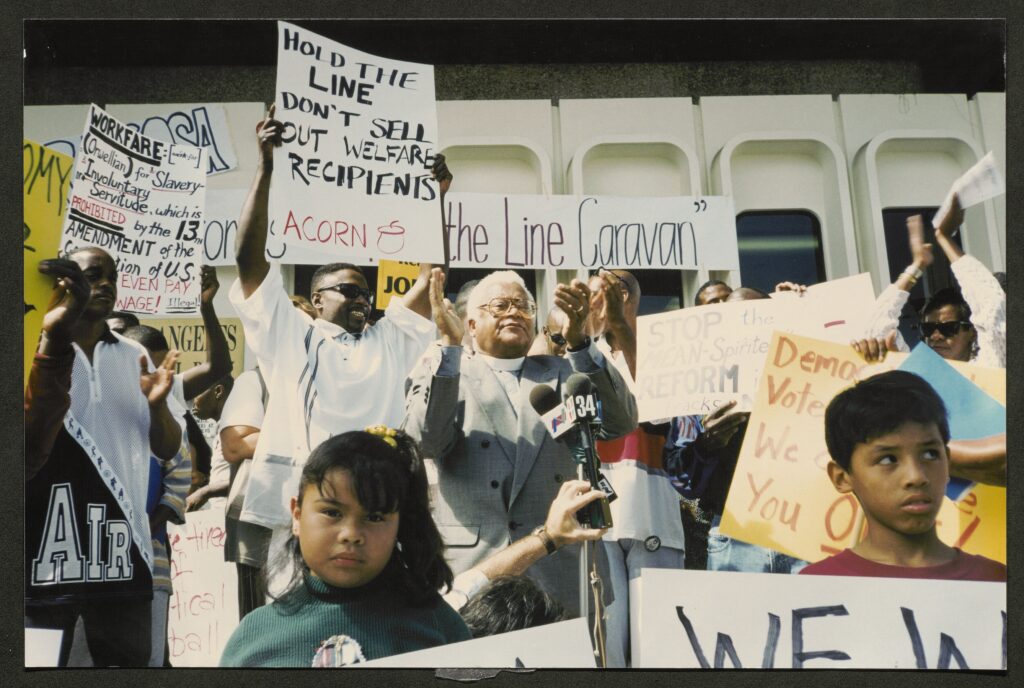
As the Living Wage Coalition expanded its outreach, the Los Angeles County Board of Supervisors announced plans to restrict eligibility to, and cut benefits for, its General Relief (or “welfare”) program in accordance with the passage of the federal Personal Responsibility and Work Opportunity Act (better known as “welfare reform”) of 1996. The legislation restructured welfare as a block grant program and restricted access to aid by imposing new work requirements and a life-time cap of five-years, and denying access to most non-citizens. The changes had a disproportionate access on women caring for children, thousands of whom were forced into the labor market often in low-wage, service sector jobs. Members of the coalition mobilized a “Hold the Line Caravan” and community meeting in response.
Fall 1996
Lobbying at City Hall
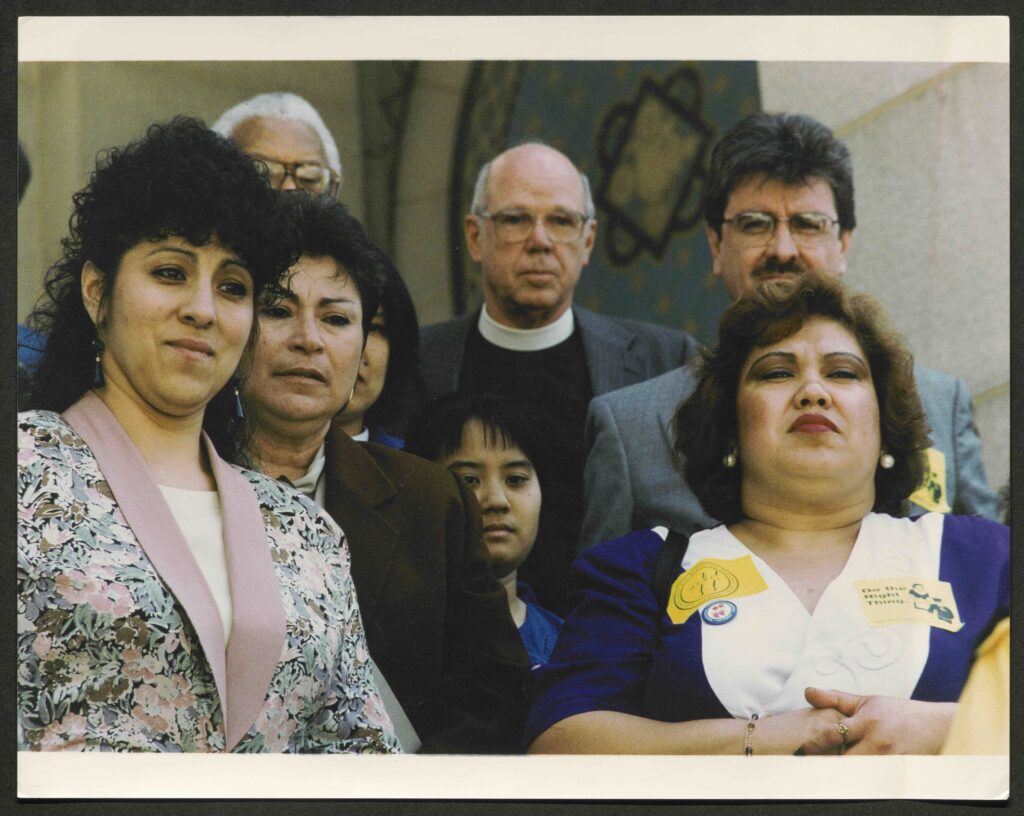
The Los Angeles Living Wage Coalition makes a major push to pass the living wage ordinance at City Council, organizing delegations of workers and community members to visit Council offices to ask for their votes. As the holidays approached, workers across Los Angeles mailed thousands of paper plates to City Hall, inscribed with messages about the food insecurity facing their families.
December 1996
Holidays Action
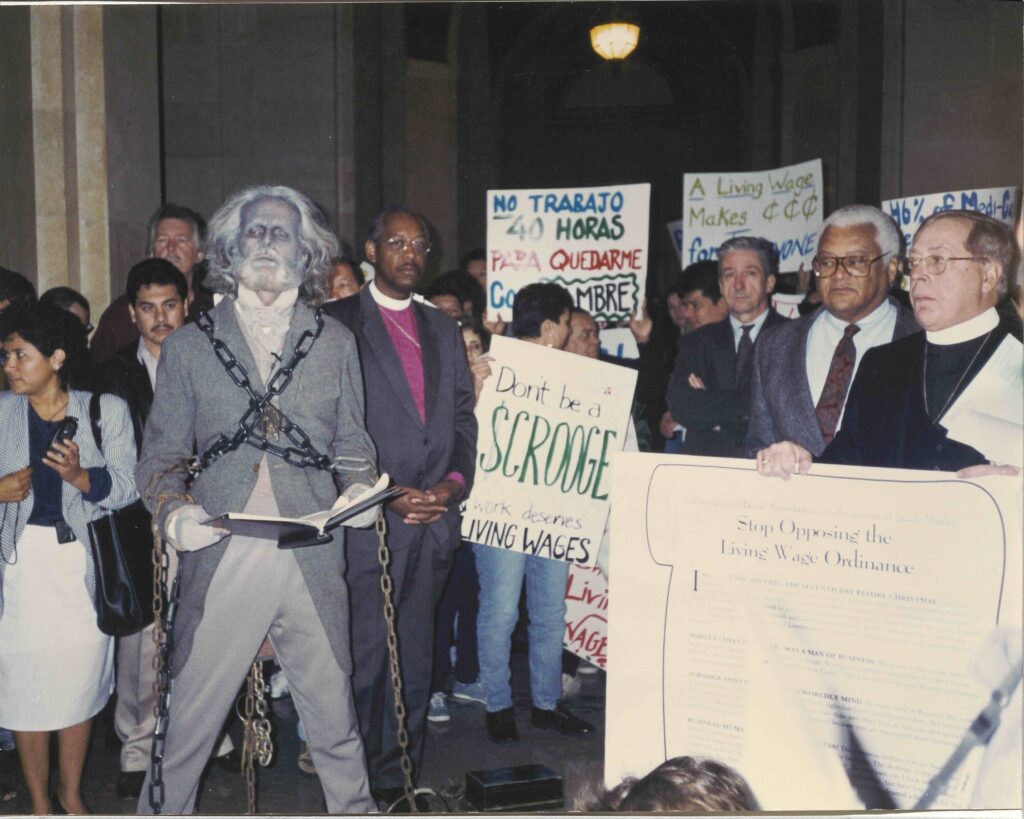
Supporters of the Living Wage Campaign packed the room at the City Council’s final session of the year in December. Coalition member Dave Clennon addressed the City Council dressed as Jacob Marley, reading an adapted version of the Christmas Story.
March 1997
Passage at the City Council
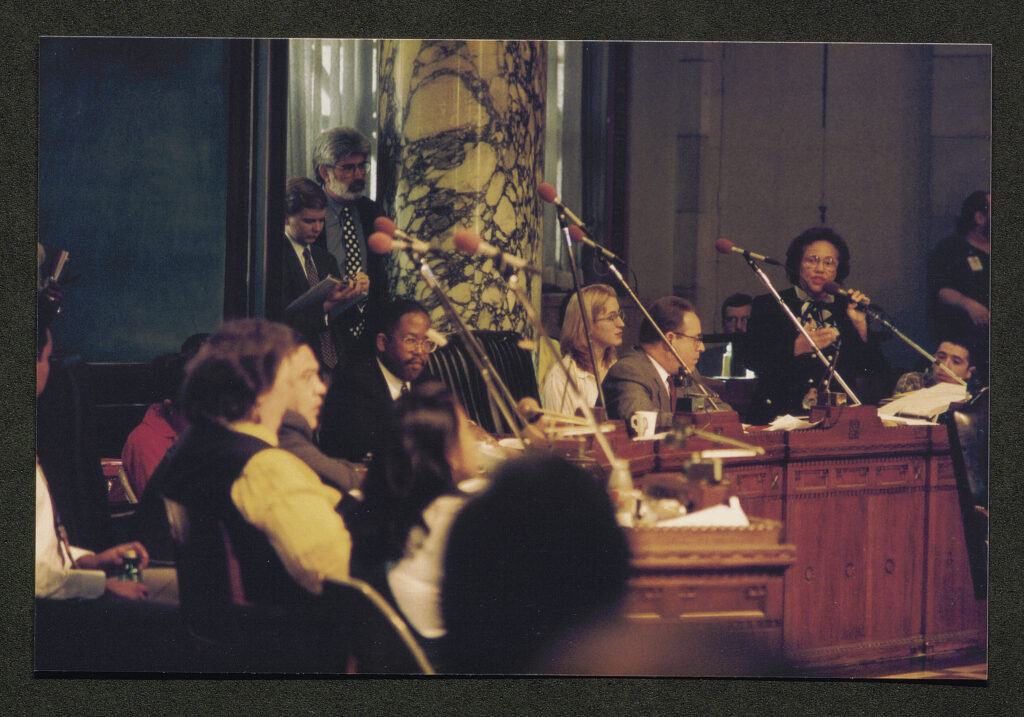
Having passed at the Personnel and Budget and Finance Committees, the Living Wage Ordinance came up for a vote in the full City Council in March. Members of the Living Wage Coalition packed the room to ensure its passage and the ordinance was approved.
April 1997
Victory at the City Council
After Mayor Richard Riordan vetoes the Living Wage Ordinance, the Living Wage Coalition rallied supporters in the City Council to vote to override his veto. By a vote of 12 to 3, the City Council overrode the veto and the ordinance became law.
By the end of 1997, similar living wage ordinances had passed in Boston, Denver, Houston and Milwaukee.
October 1997
Living Wage at LAX
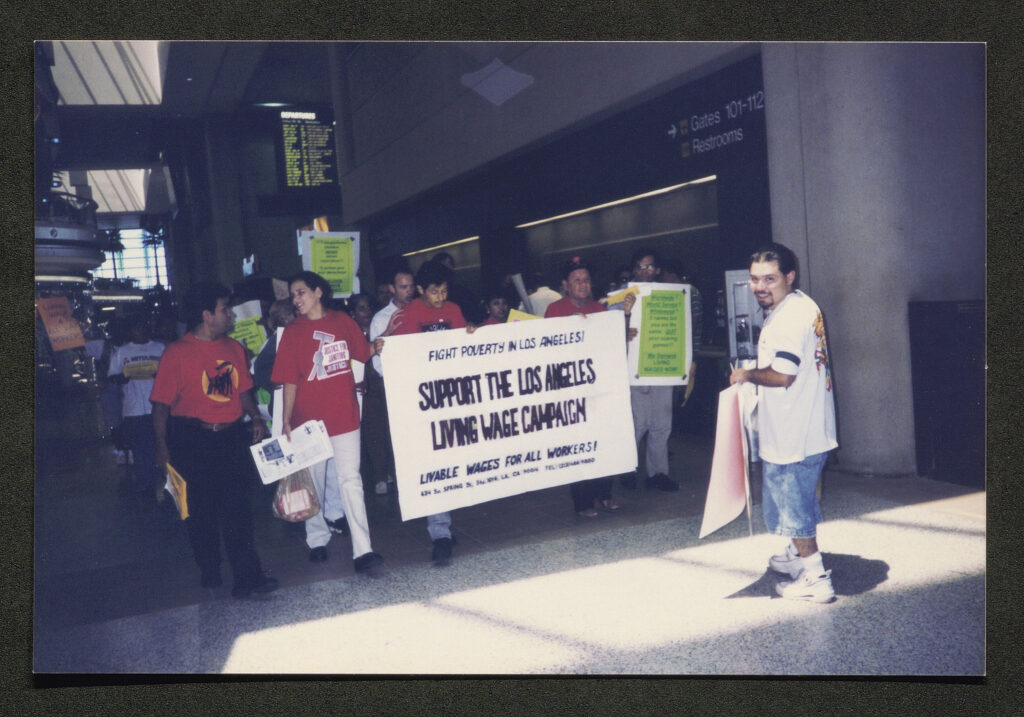
The Living Wage Coalition and Justice for Janitors (SEIU Local 399) organized a demonstration at LAX to protest the exemption of baggage handlers, wheel chair runners, security officers, and janitorial staff who worked at the airport from the protections of the Living Wage Ordinance.
Summer 1998
Expansion
The campaign for a living wage in San Jose, CA, began in 1998, lead by the Working Partnerships Study Group and the Interfaith Council on Religion, Race, Economics, and Social Justice.
The Los Angeles Episcopal diocese pushed its National Convention to adopt a recommendation that all congregations pay their workers a living wage.
Fall 1998
SMART
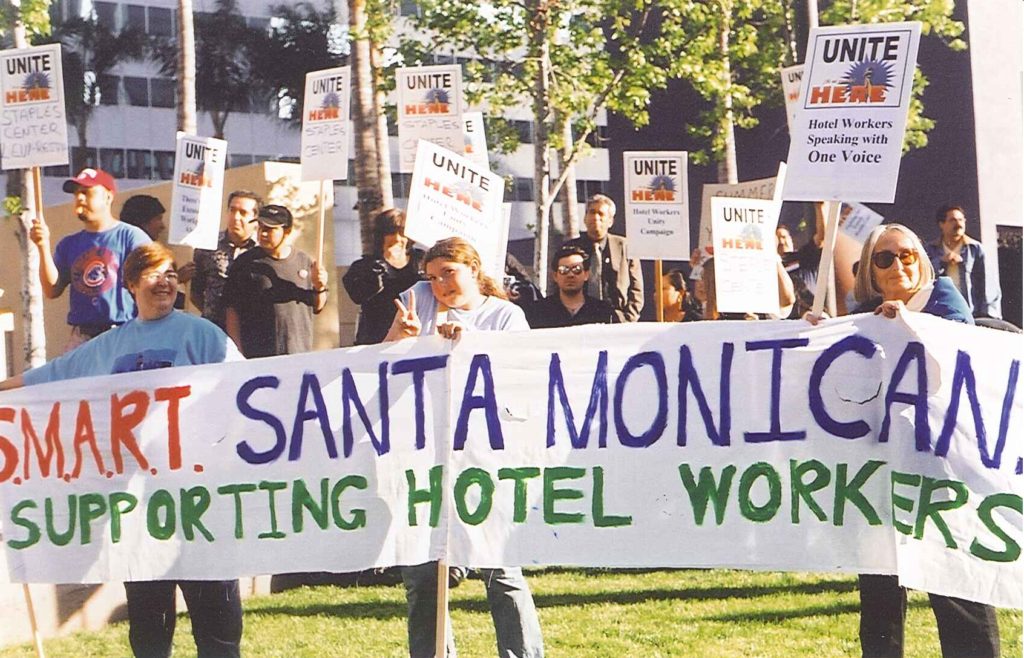
Amidst a tense union fight at the Miramar Sheraton Hotel, supporters of the Los Angeles Living Wage Campaign extended their efforts west by organizing Santa Monicans Allied for Responsible Tourism (SMART).
April 1999
L.A. County Living Wage
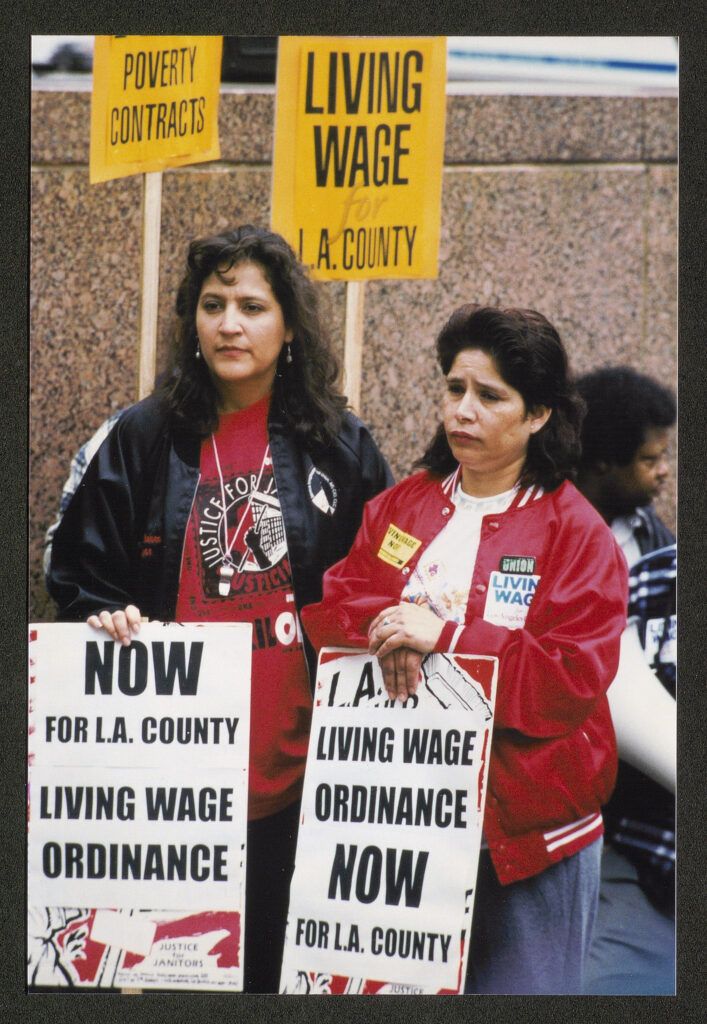
Religious leaders from CLUE joined members of SEIU 660 for a rally at the Los Angeles County Board of Supervisors to push a county-level Living Wage Ordinance. The ordinance passed and was adopted in June 1999.
April 2000
Journey Towards Justice
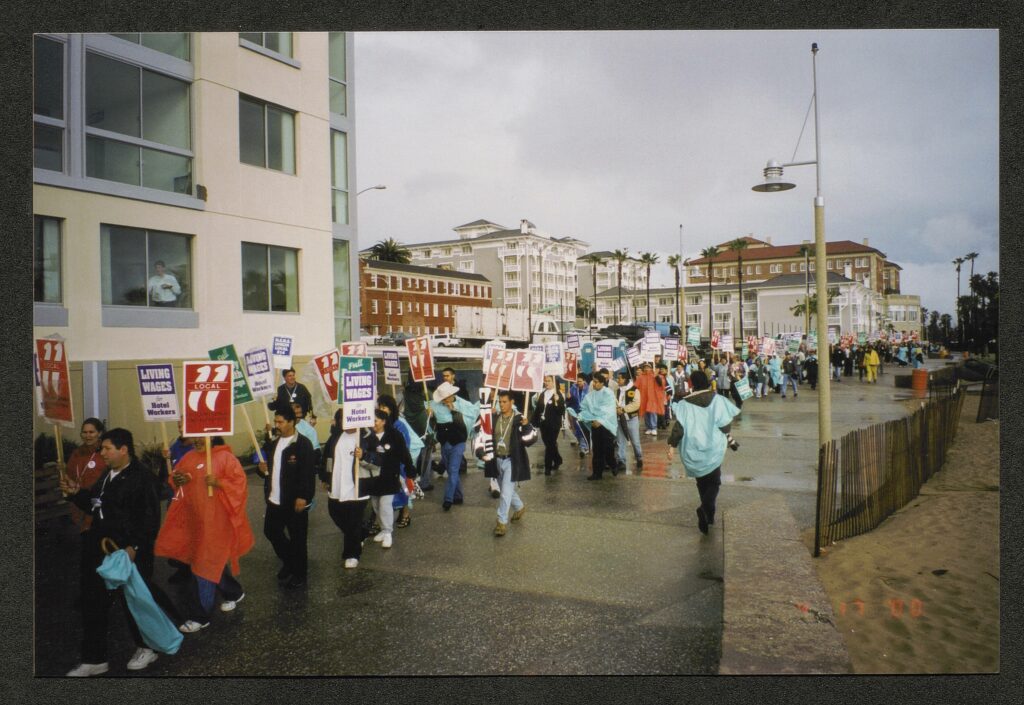
SMART mobilizes a “Journey Towards Justice” march along the beachfront boardwalk with members of HERE and CLUE to raise public support for a proposed a living wage ordinance was that would raise wages for an estimated 3,000 housekeepers, valet drivers, restaurant workers and security guards in the beachfront hotel district.
Fall 2000
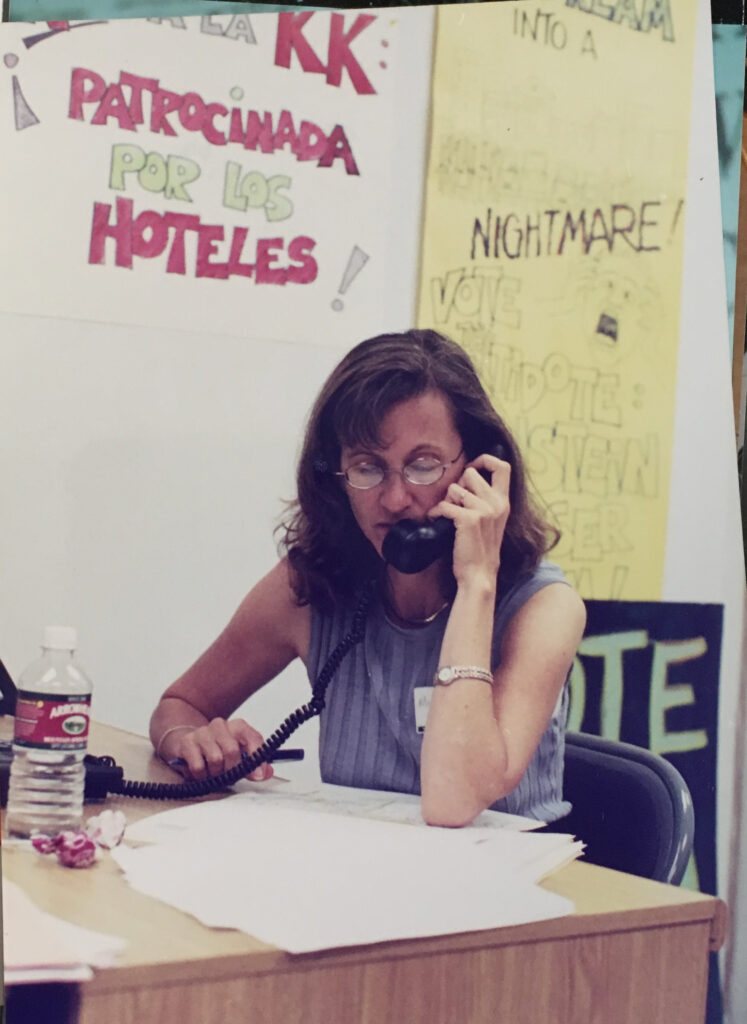
No on Prop KK
Opponents of the Santa Monica Living Wage ordinance launch a deceptive counter-campaign, gathering signatures for a ballot initiate called Proposition KK. SMART and its allies quickly had to pivot their efforts from support for the living wage ordinance to defeating Prop KK “The Fake Minimum Wage.” Their efforts were successful: a solid majority of Santa Monica voters rejected Prop KK. The City Council later voted to pass a living wage ordinance limited to large employers in the coastal business zone.
By the end of 2001, 63 cities across the U.S. adopted living wage proposals.
29 states followed suit, passing legislation to raise the minimum wage for workers.
Congress raised the federal minimum wage to $7.25/hour in 2009, where it has remained since.