
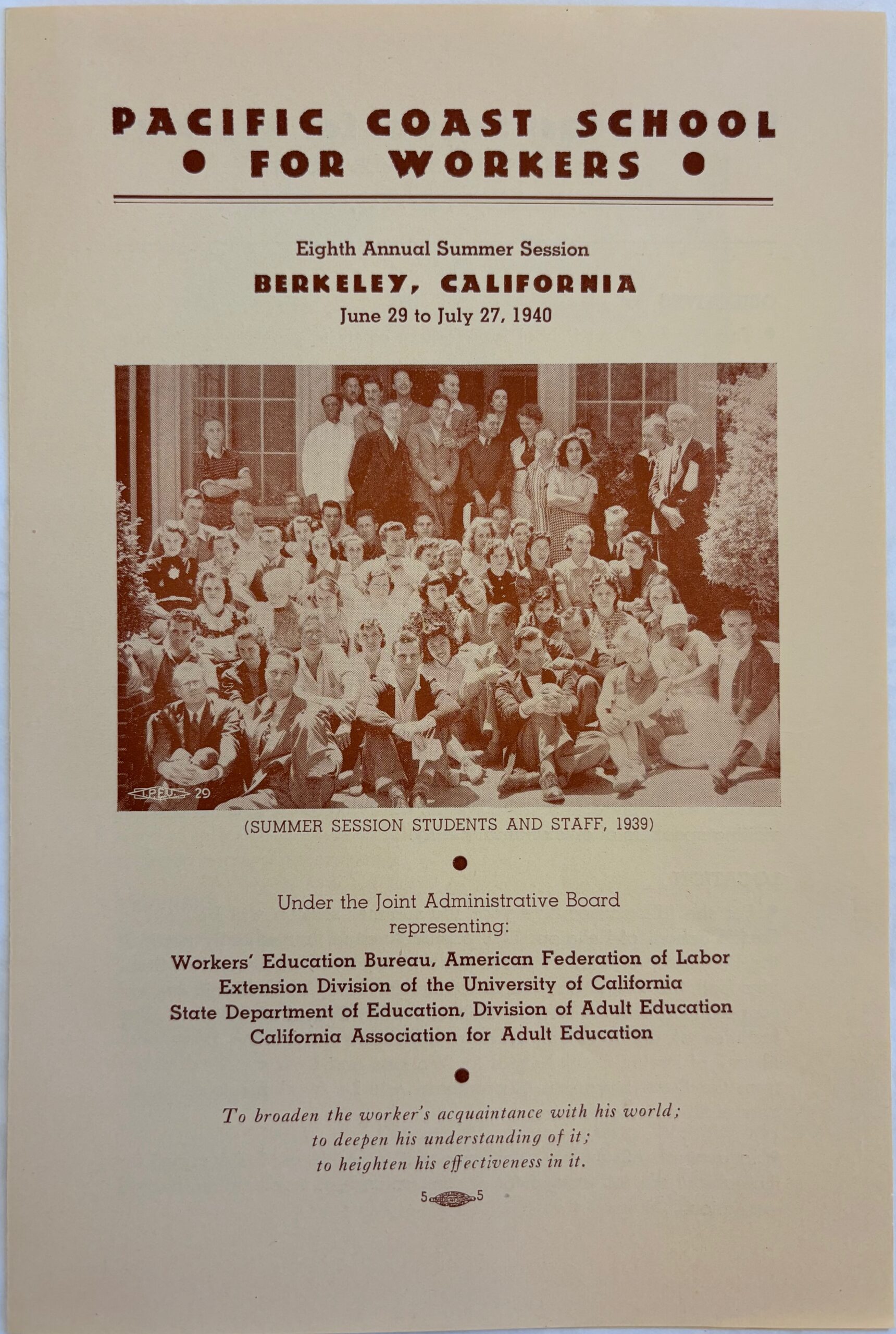
Between 1933 and 1945, the University of California collaborated with California Department of Education and the California Federation of Labor to offer workers’ education courses through the University Extension. Known first as the Western Summer School for Workers, then as the Pacific Coast School for Workers, and finally as the Pacific Coast Labor School, the program trained hundreds of rank-and-file union members and set the stage for the founding of the UC Institute for Industrial Relations after World War II.
The University Extension hired retired schoolteacher and AFT member John Kerchen in 1922 to lead up a new initiative in “workers’ education.” It was part of an early wave of institution building that saw the launch residential training programs like Brookwood Labor College in New York, the Bryn Mawr Summer School for Women Workers, and the University of Wisconsin School for Workers. The California program took on new life in 1933 when a group of garment union activists—immigrant women who had attended Brookwood and other programs—helped to organize the first Western Summer School for Workers on the campus of Occidental College. A leading figure in this group was Sadie Goodman, a Jewish immigrant garment worker who organized for the Amalgamated Clothing Workers of America and the YWCA.
UC administrators were ambivalent about the workers school. On the one hand, it represented an expansion of UC education to a new and potentially large audience. As late as 1940, only 10% of U.S. adults had any college experience at all. Few imagined the massive expansion of college enrollment that would come to pass after World War II. Instead, hopes for expanded college access focused on program that would develop the knowledge and skills of working people and return them to the jobs and communities.
On the other hand, business leaders and conservative members of the UC Regents were hostile to the idea of the UC supporting the growth of labor unions and feared the school would promote radicalism. After a controversy over a leftist instructor in 1934, the school moved to UC Berkeley in the summer of 1935 prompting business leaders to urge UC officials to cut ties. Afterwards the school met at the Pacific School of Religion in Berkeley.
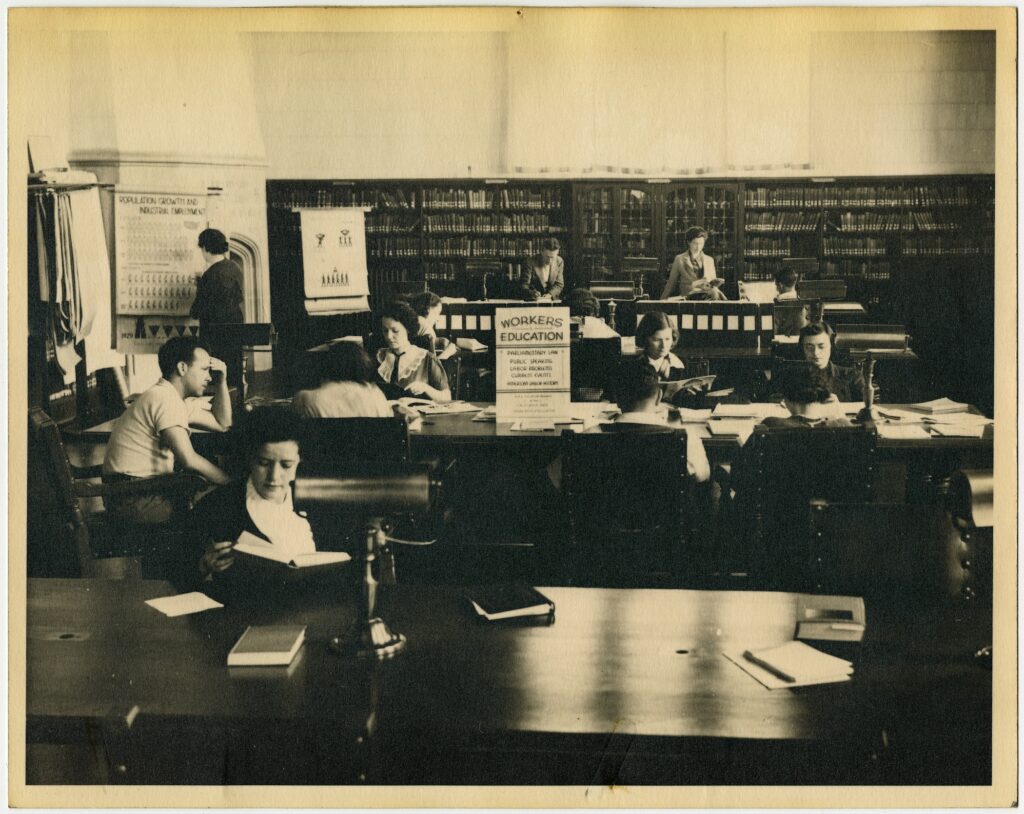
In reality, UC leaders and faculty had little to fear when it came to radicalism. Kerchen and other leaders of the school were careful not to admit students with obvious leftist training, and the curriculum emphasized practical over political education. Even so, school leaders assessed that most of the students were sympathetic to radical change while the instructors were typically moderate socialists and New Dealers. Given that the unionization was not widely accepted by business leaders, even a moderate labor school was bound to court controversy.
As the political power of unions grew in the 1940s, university leadership and sympathetic faculty laid the groundwork to bring the workers’ education program formally into the UC with expanded state funding. They hoped faculty leadership would ensure a politically moderate labor education program, and an expansion of policy research to serve both labor and management. UCLA economics professor Paul Dodd and President Sproul pitched the idea of a UCLA “institute” on labor relations to Governor Earl Warren over lunch in December 1944. Eager to court the votes of moderate labor voters, the Republican governor included the idea in his 1945 budget proposal, and during negotiations funds were added for institutes at both the Los Angeles and Berkeley campuses. Dodd became the first director at the UCLA Institute for Industrial Relations IIR). He recommended UC Berkeley hire his former War Labor Board colleague Clark Kerr for the job on the northern campus.
The Pacific Coast Labor School did not return after the war, but the new IIR picked up and expanded educational programs for workers. However, union leaders grew critical of the IIRs as they expanded training program for managers. Following lobbying by the labor movement, the UC established new centers within the IIRs in 1964 to focus on the specifically on union-related research.