
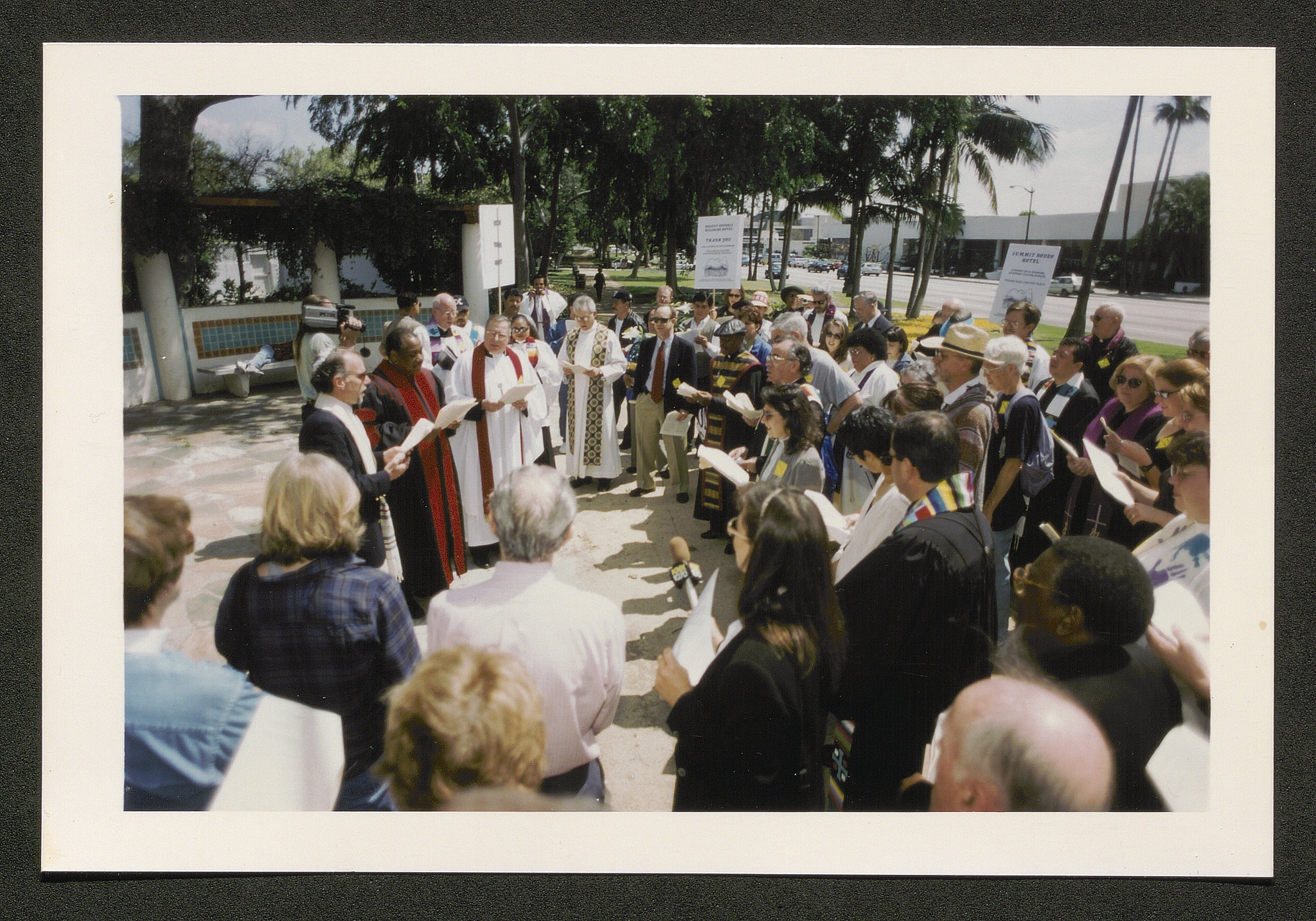
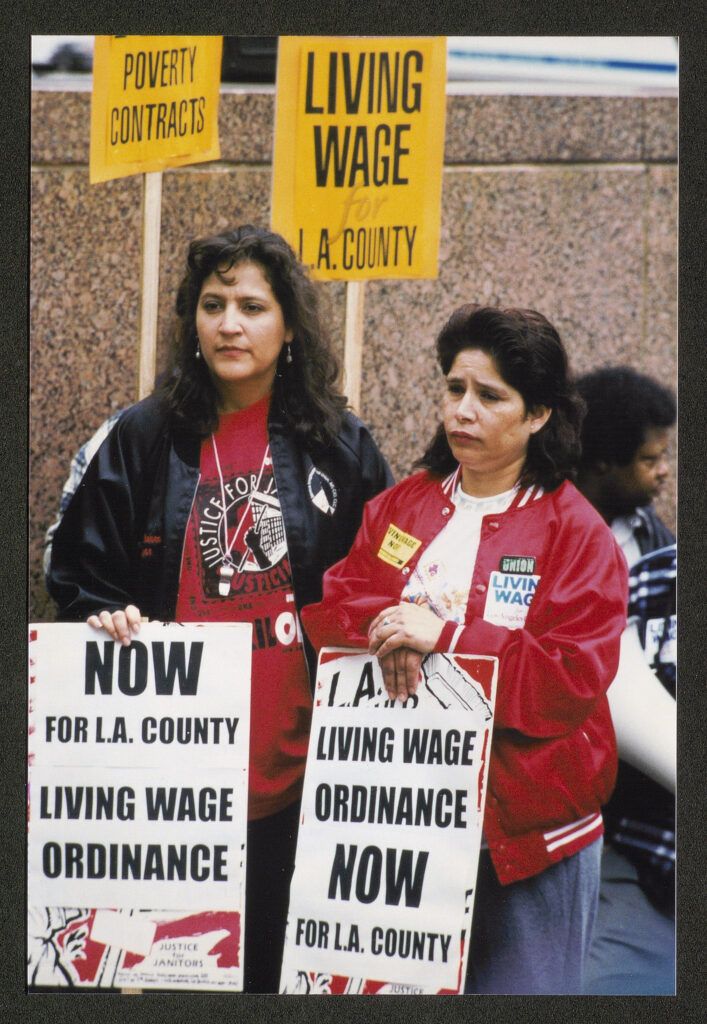
After years of austerity politics and economic transformations that devastated working-class communities, religious leaders, workers, and community activists came together to fight for a living wage in Los Angeles. The premise of their campaign was seemingly simple — all working people deserve to live in dignity — but provided a capacious framework that encompassed a wide variety of issues and concerns. The coalition’s victory over the opposition of the mayor and the city’s powerful business interests demonstrated the effectiveness of their community-based approach to municipal governance.
“We have the right and responsibility to see that such employees are paid enough to support themselves and their families in basic dignity. We have a right and a responsibility to say to businesses: If you want to benefit from our tax dollars, then we can require that all who do the labor are paid at least a living wage.”
– Bishop Frederick H. Borsch, Rabbi Leonard I. Beerman, Bishop Roy I. Sano, “Yes it Makes Ethical and Economic Sense,” Los Angeles Times, Dec. 30, 1996.
The 18-month long campaign began in 1996, when several, overlapping developments reached a crisis point. Some were macro level trends: factory closures and the immiseration of the social safety net under the Reagan administration; the struggle to meet the material needs of Central American migrants seeking refuge from imperialist wars; an affordable housing crisis that displaced thousands of low-income tenants; and widening economic inequality resulting from the weakening of unions and the financialization of the American economy. Others were more immediate and localized results of policymaking at the municipal level, including then-Mayor Richard Riordan’s decisions to subcontract city services to private, for-profit companies and to embrace business subsidies as a means of stimulating economic growth. The impacts of Riordan’s policies were particularly sharp at the Los Angeles International Airport (LAX), where good, union jobs were replaced with low-wage, often part-time, non-union ones. For a variety of individuals and constituencies, the Living Wage Campaign provided an urgent opportunity to fight back against neoliberal austerity in local governance and improve the standard of living to ensure that working people did not have to raise their families in poverty.
Passed in March 1997, despite of an initial veto by the mayor, the Los Angeles Living Wage Ordinance, established a minimum wage of $7.25 per hour for all workers on public service contracts with the city and a $1.25 per hour subsidy for workers without private health insurance, as well as 12 paid days off per year. It applied to all firms holding concession agreements with the city worth $25,000 or more per year and to businesses receiving subsidies from the city of $1 million per year or more (or $100,000 on an annual basis). Legal and policy experts, union members, and community advocates worked in close collaboration to develop and refine the ordinance, including by inserting detailed plans for its implementation. While the ordinance did not raise the wages for all workers in L.A., it was substantially broader in its coverage than those in other cities, its success contributing to a national movement. Some 63 cities passed similar living wage policies by 2001 and, five years after that, 19 states had raised their minimum wages above the federal level (then $5.15/hour).
Winning the Living Wage was the first major campaign of LAANE (Los Angeles Alliance for the New Economy, then known as the Tourism Industry Development Council), who helped to conceive of and craft the ordinance in close collaboration with members of HERE Local 11 (representing hospitality workers) and SEIU Local 399 (representing building services workers). LAANE also actively engaged local religious leaders in their efforts, the campaign inspiring the creation of CLUE (Clergy and Laity United for Economic Justice), and worked closely with various grassroots community organizations beyond the labor movement, including the local chapter of ACORN (the Association of Community Organizations for Reform Now). In the years that followed, members of the Living Wage Coalition fought to expand the ordinance to include workers at LAX and to pass similar ordinances at the county level as well as in West Hollywood, Pasadena, and Santa Monica. They worked together to prevent cuts to social services in the wake of welfare reform and spearheaded new collaborative approaches to economic policy development that protected workers and residents alike. Union partners, in turn, embraced more civic-minded strategies and community-based methods to their organizing work, introducing new strategies that some today recognize as “whole worker organizing” or “bargaining for the common good.”
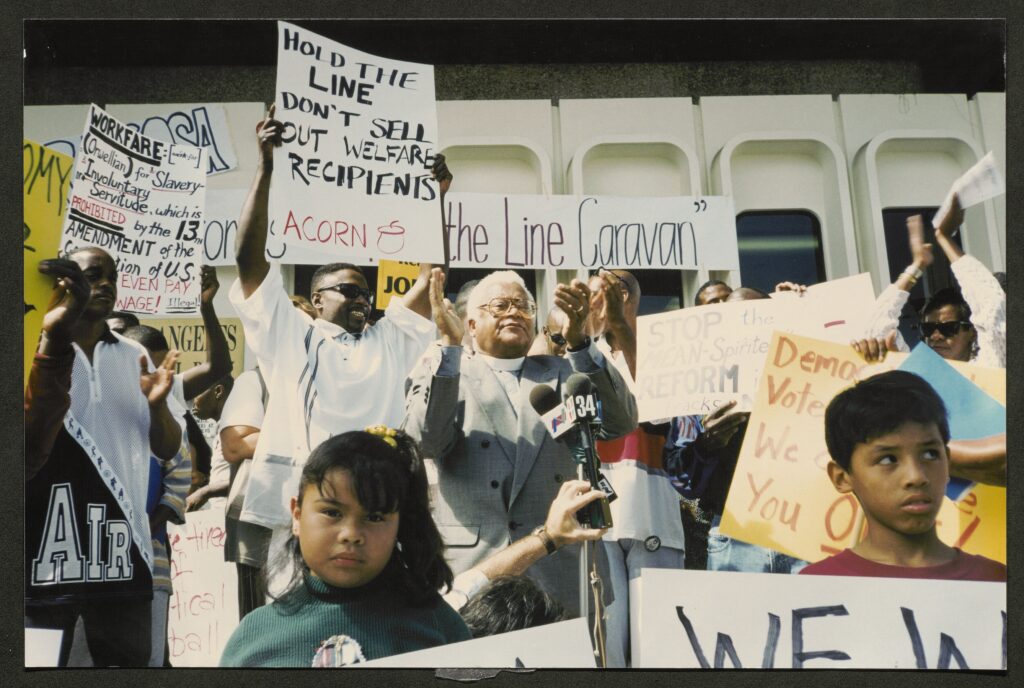
Tracing the origins of these strategies to the Los Angeles Living Wage campaign, when working-class communities in L.A. and across the U.S. faced mounting job losses, poverty, and displacement, demonstrates that by working together, a dedicated group of people can forge their own models of urban governance and make positive change in their local communities.
Collection Highlights
-
Lobbying Day At City Council
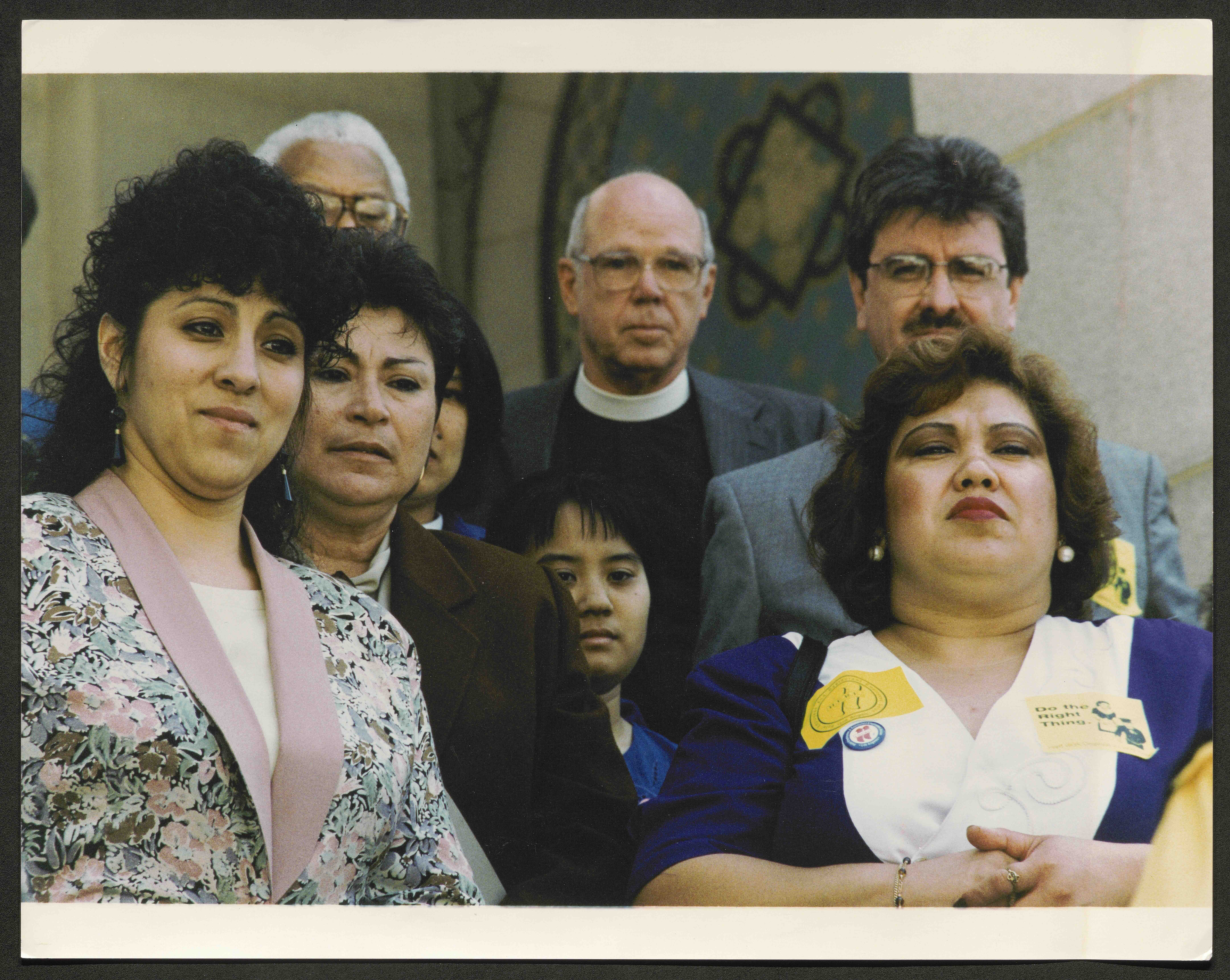
Read more: Lobbying Day At City CouncilThe Living Wage was the first major campaign of LAANE (Los Angeles Alliance for the New Economy, then known at the Tourism Industry Development Council), who helped to conceive of and craft the ordinance in close collaboration with HERE Local 11 (representing hospitality workers) and SEIU Local 399 (representing building services workers). To ensure its…
-
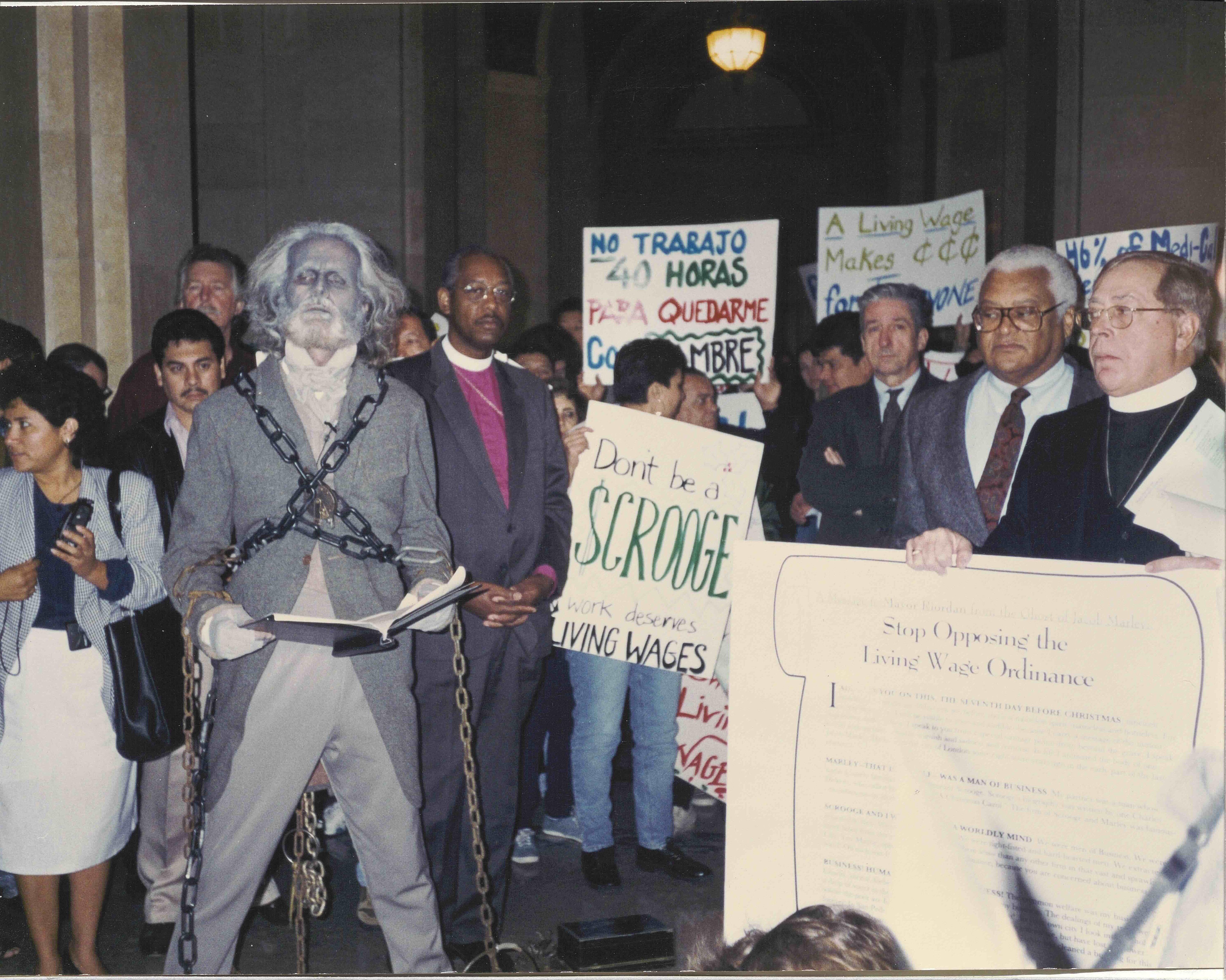
Living Wage Holidays Action at City Hall
Read more: Living Wage Holidays Action at City HallIn 1996, as the Los Angeles City Council’s holiday recess approached, members of the Living Wage coalition organized a Christmas-themed action at the last committee hearing on the ordinance. In the preceding weeks, they had sent delegations of workers to council offices and sent heartfelt Thanksgiving messages written by workers and their families to each…
-
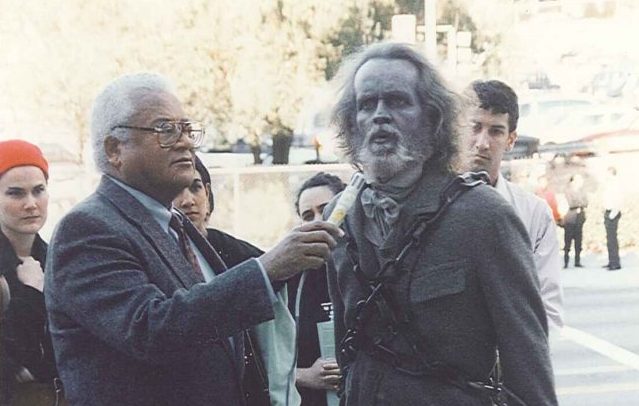
Don’t be a Scrooge: Ghost of Christmas Past visits L.A. City Council
Read more: Don’t be a Scrooge: Ghost of Christmas Past visits L.A. City CouncilThis video produced by the Los Angeles Alliance for a New Economy documents elements of the Living Wage campaign in Los Angeles. After months of organizing and outreach, the campaign crested in December 1996, with a holidays-themed action at City Hall. Dressed as the ghost of Jacob Marley from Charles Dickens’ “A Christmas Carol,” community…
-
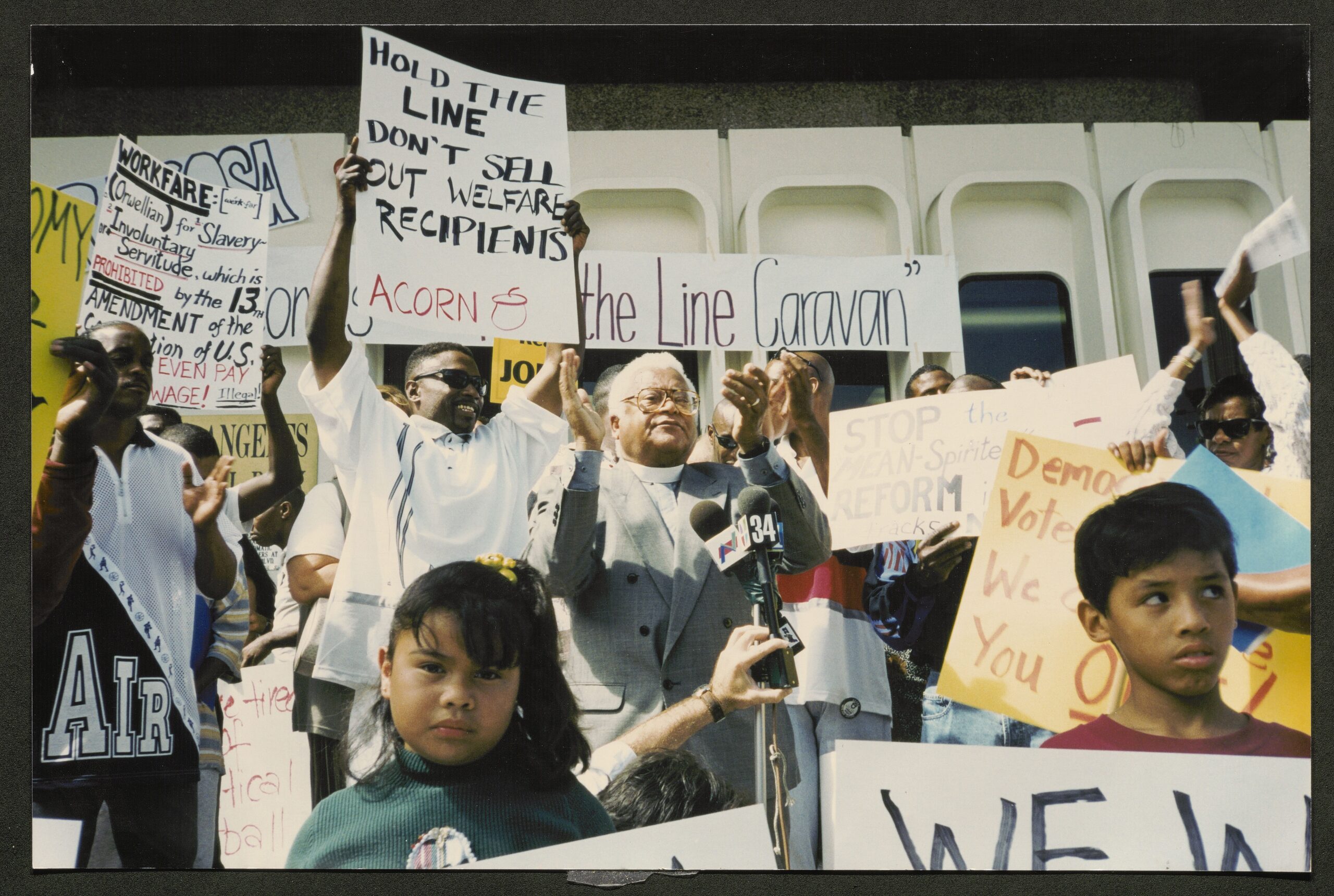
Hold the Line Caravan
Read more: Hold the Line CaravanAs the Living Wage Coalition expanded its outreach, the Los Angeles County Board of Supervisors announced plans to restrict eligibility to, and cut benefits for, its General Relief (or “welfare”) program in accordance with the passage of the federal Personal Responsibility and Work Opportunity Act (better known as “welfare reform”) of 1996. Coalition members, including…
-
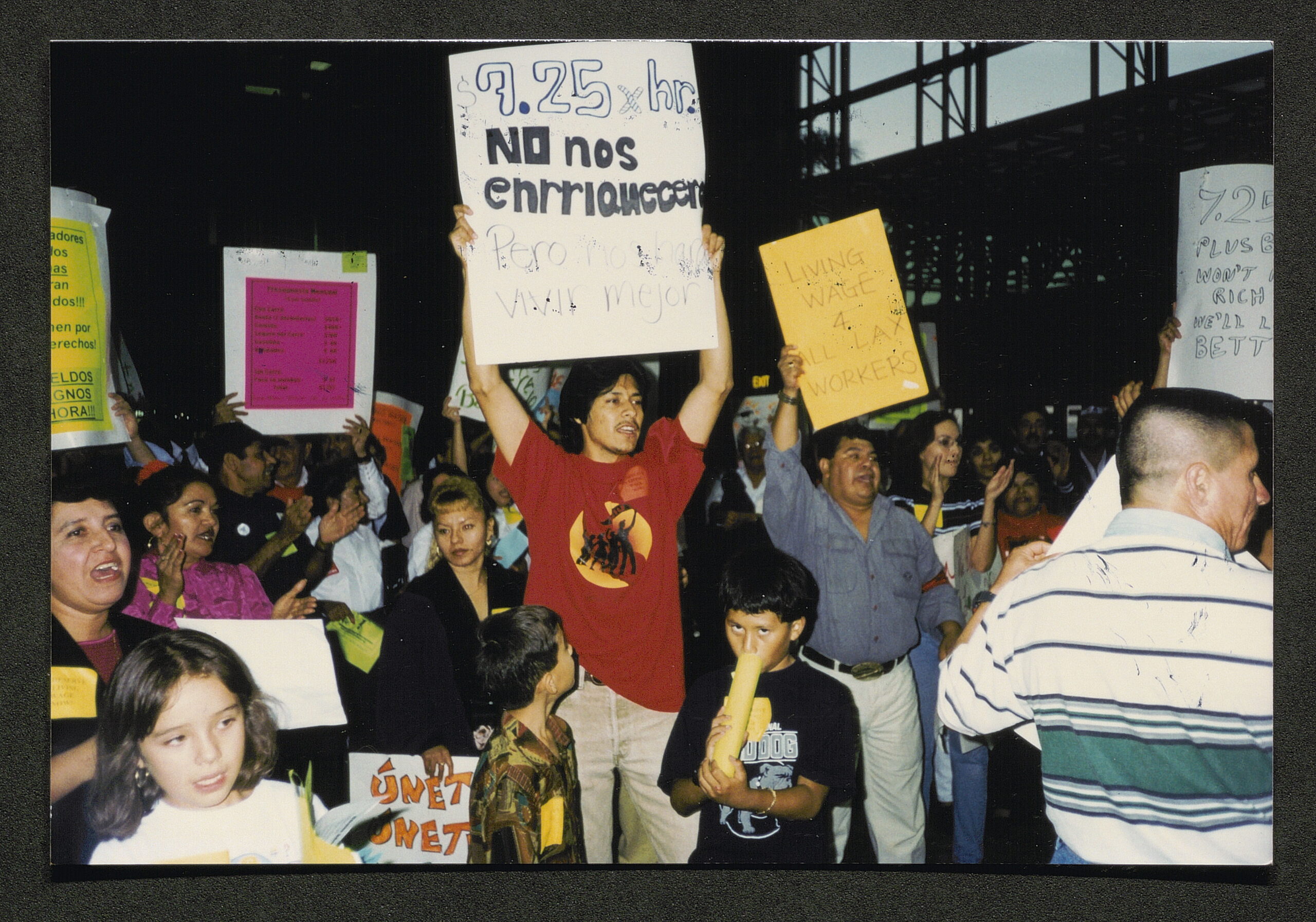
Expanding the Living Wage at LAX
Read more: Expanding the Living Wage at LAXAs written, the Los Angeles Living Wage Ordinance only applied to large companies with contracts with the Los Angeles city government, exempting some 2000-3000 low-wage workers at the Los Angeles International Airport (LAX), including baggage handlers, wheelchair runners, security officers, and janitorial staff. Their exclusion from the ordinance was based on a legal technicality: while…