
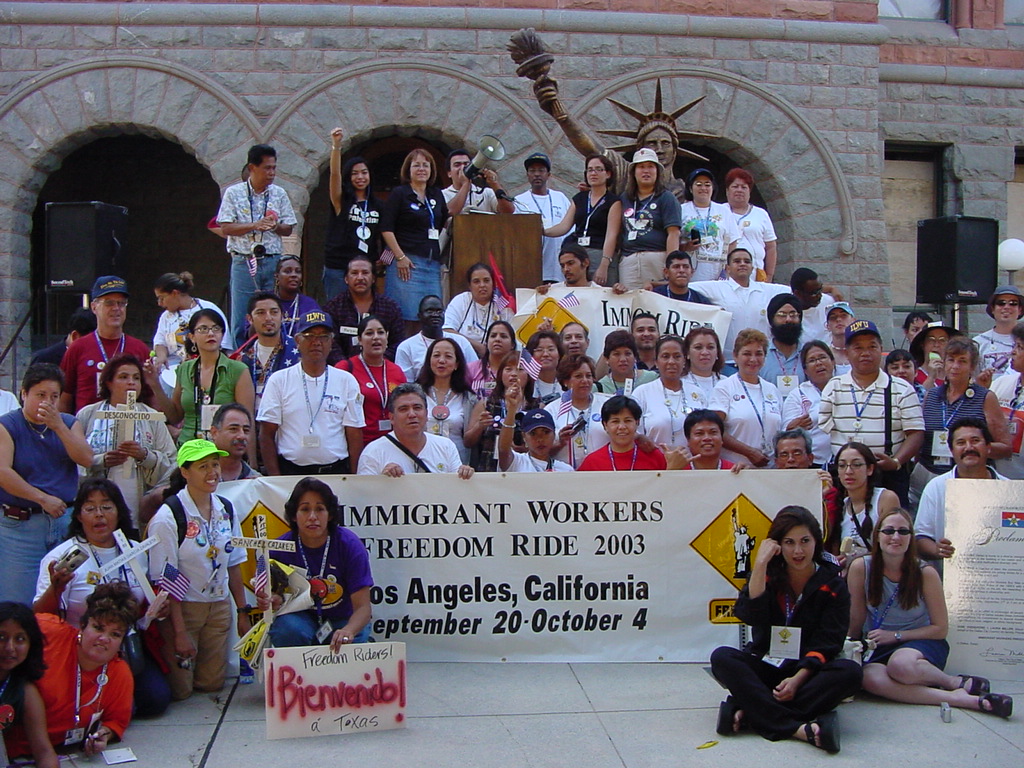
In September 2003, immigrant workers from across the country joined a mass mobilization called the Immigrant Workers Freedom Ride. For twelve days, delegations from 10 cities travelled on buses across the country, making nearly 100 stops along the way, including in Washington D.C. where the Freedom Riders met with Congressional leaders to advocate for immigration reform. The mass mobilization drew its inspiration from the Black freedom struggle, when in 1961, Black and White civil rights activists, many of them students, rode interstate buses into the Jim Crow South to challenge racial segregation. Although the Supreme Court had ruled racial segregation in interstate travel to be unconstitutional years prior, the Freedom Riders aimed to test the limits of enforcement. Along the way, they faced arrests, violence, and racial terror, particularly in Alabama where buses were repeatedly firebombed by the KKK. Freedom Riders of that generation, including Rev. James Lawson and Congressman John Lewis, helped to organize the 2003 event and offered their support to the participants on stops along the way.
Preparations for the Immigrant Workers Freedom Ride began months earlier at the National Convention of the Hotel Employees and Restaurant Employees Union (HERE). HERE delegates then pushed to pass a resolution at the 2002 National Convention of the AFL-CIO pledging the federation’s commitment to a national mobilization that would bring about “meaningful legislative reform” on behalf of immigrant workers. Local central labor councils began preparations, trainings, and fundraisers, recruiting union members to join the Freedom Ride. In total, 900 riders representing 50 nations travelled thousands of miles to promote the cause of immigrant rights, working to develop new labor-community alliances, register naturalized immigrant voters, and encourage participation in the labor movement and the political process along the way.
As in 1961, the Freedom Riders faced opposition as they traveled. The Los Angeles bus was stopped by U.S. Border Patrol in Texas, with every passenger forced to produce proof of citizenship. But despite understandable fear, everyone on the bus, citizen and non-citizen alike, exercised their rights to remain silent, choosing to sing “We Shall Overcome” together instead.
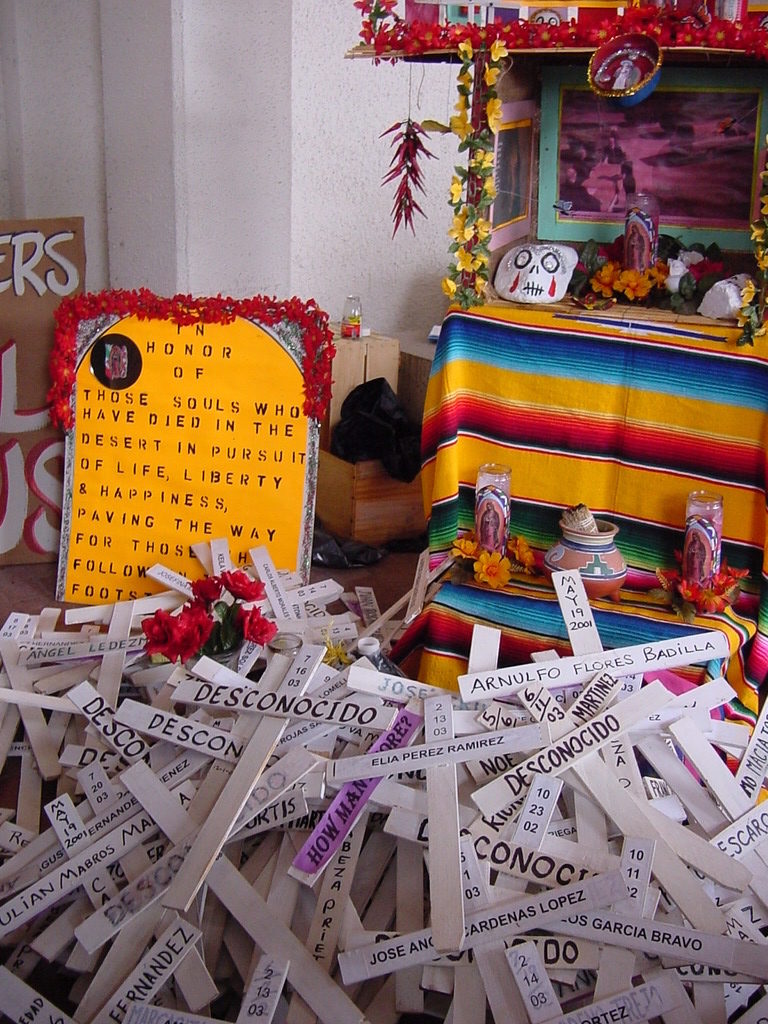
Several Freedom Riders were taken in custody and subjected to additional questioning, but one by one they were all released. Some said as they waited that they reflected on a previous stop they had made in Nogales, AZ near the fence that divides the U.S.-Mexico border, where they were presented with simple white crosses honoring those who had died during the journey, some of them bearing names, others “Desconocido” to honor the unknown dead. Four hours later, the Los Angeles Freedom Riders celebrated when they were all allowed to continue on their way.
The Freedom Ride culminated in New York where the delegations from across the country converged. In the shadow of the Statue of Liberty, over 100,000 people celebrated their accomplishments and vowed to keep up their fight for immigration reform. In her remarks at the rally, Maria Elena Durazo, National Chair of the Immigrant Workers Freedom Ride, asked the crowd at the rally to echo her in declaring, “We have no fear. We will Not Hide. This is our Country. We are the Americans.”
Watch: a longer documentary about the Los Angeles Freedom Riders produced by UNITE HERE Local 11 https://www.unitehere11.org/los-angeles-immigrant-workers-freedom-ride/
Read: Steven Greenhouse, “Riding Across America for Immigrant Workers,” New York Times Sept. 17, 2003 https://www.nytimes.com/2003/09/17/us/riding-across-america-for-immigrant-workers.html